The Biosimilar Patent Cliff Is Coming. The Real Constraint May Be Manufacturing Talent.
The Biosimilar Patent Cliff Is Coming. The Real Constraint May Be Manufacturing Talent.
As another wave of blockbuster biologics approaches loss of exclusivity, the conversation around biosimilars is starting to move beyond pricing, access and regulatory pathways. Increasingly, the question is not simply who can develop a biosimilar. It is who can manufacture it reliably, flexibly and at scale.
That point was made recently by Lars Petersen, President and CEO of FUJIFILM Biotechnologies, who warned that contract development and manufacturing organisations need to prepare for the coming surge in biosimilar demand. Endpoints reported that Petersen believes CDMOs will need broader capabilities as the biopharma patent cliff approaches, with agility, flexible manufacturing footprints and operational integration becoming more important.
It is an important comment because FUJIFILM Biotechnologies is not a small player watching from the sidelines. Fujifilm describes the business as a world-leading CDMO for biologics, vaccines and advanced therapies, with Lars Petersen leading a global organisation across Denmark, the UK, the US and Japan.
The broader industry context is clear. A significant group of biologic medicines are approaching patent expiry between 2026 and 2030, with Cytiva noting that biologics worth more than $200 billion in annual revenue are set to lose patent protection by 2030. Key examples include Kadcyla and Taltz in 2026, Trulicity and others in 2027, then major oncology products such as Keytruda and Opdivo in 2028, followed by products including Ocrevus in 2029. [
That matters because biosimilars are not simple copycat products. Unlike small-molecule generics, biologics are complex therapies produced through sophisticated living systems, requiring highly controlled development, process transfer, quality systems and commercial manufacturing. This makes CDMO capability central to the next phase of the market.
For CDMOs, the challenge is not just building more capacity. It is building the right type of capacity.
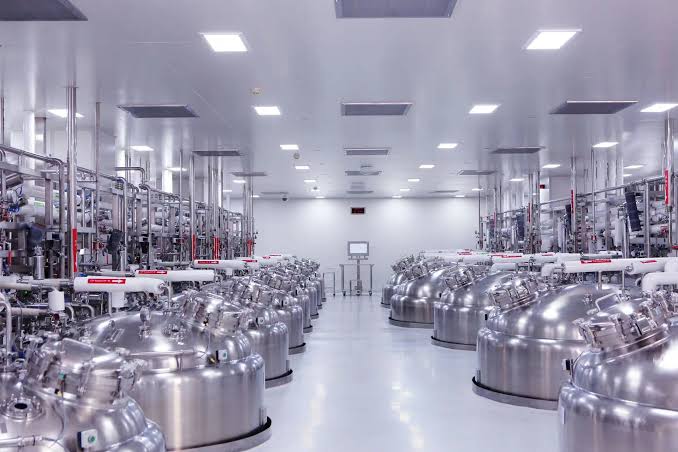
Fujifilm has already been investing heavily in this direction. Fierce Pharma reported that Fujifilm Biotechnologies has opened a large new biomanufacturing plant in North Carolina, described as a clone of its Denmark facility, and is equipping the site with additional large-scale bioreactors. The same report noted further activity at facilities in Japan and Billingham in the UK. Fujifilm has also said that Lars Petersen was responsible for major global large-scale commercial operations and oversaw $6.2 billion of global expansions in Hillerød, Denmark and Holly Springs, North Carolina.
This is the significant point for me: when a CDMO leader talks about agility, flexibility and AI-enabled operations, they are not talking about technology for its own sake. They are talking about the operating model required to manage a more volatile, higher-volume and more complex biologics manufacturing market.
The patent cliff creates pressure in several directions at once.
Firstly, customers will need speed. Biosimilar developers will want to move quickly once commercial windows open. Secondly, manufacturing economics will matter more. As more competitors enter, cost, yield, quality and utilisation become critical. Thirdly, sponsors will need confidence that external manufacturing partners can move from development through commercial supply without losing control of quality or timelines.
That is why Petersen’s comments about CDMOs needing to be ready are so relevant. This is not just a capacity story. It is a readiness story.
It is also a talent story.
If demand increases for biosimilar manufacturing, then the pressure will fall on the people and functions that sit between science and commercial supply. CDMOs will need more than commercial intent and stainless-steel capacity. They will need teams that can execute.
That means growing demand for:
- MS&T leaders who can manage process transfer and commercial readiness.
- Process development specialists who understand biologics scale-up.
- CQV and validation professionals who can support fast but compliant capacity deployment.
- Manufacturing engineers who can improve reliability, throughput and flexibility.
- Automation and digital manufacturing experts who can integrate data, control systems and AI-enabled workflows.
- Quality leaders who can maintain compliance across increasingly complex global networks.
- Site and operations leaders who can manage growth without compromising culture, safety or delivery.
This is where the discussion around AI becomes interesting, but perhaps slightly overhyped if viewed in isolation. FUJIFILM Biotechnologies has referenced AI in the context of redefining quality, speed and reproducibility in biologics manufacturing. But AI will not solve the manufacturing challenge by itself. It will need to sit alongside strong process understanding, disciplined operations, reliable data, capable people and mature quality systems.
In other words, AI may improve the factory. It does not replace the need for people who know how a biologics factory really works.
For CDMOs, the winners may not simply be the companies with the largest announced capacity. They may be the ones that can combine capacity with technical flexibility, repeatable operating models, regulatory confidence and experienced teams who know how to move products from development through commercial production.
That also creates a strategic issue for biopharma companies selecting partners. As the biosimilar opportunity grows, outsourcing decisions will become more important. A CDMO will not just be a vendor. It may become the difference between being ready for a market window or missing it.
For the talent market, I see three clear implications.
First, biologics manufacturing experience will remain at a premium, especially for people who have supported tech transfer, scale-up, validation and commercial readiness.
Second, CDMOs will compete harder for operational leaders who can manage growth, standardisation and site performance in regulated environments.
Third, the line between manufacturing, digital, quality and engineering will continue to blur. The most valuable leaders will be those who can operate across those boundaries rather than sit in a narrow functional lane.
The biosimilar patent cliff is often discussed as a revenue threat for originator pharma and a market opportunity for biosimilar developers. That is true, but incomplete.
It is also a manufacturing stress test.
And if Petersen is right, CDMOs that want to benefit from the next biologics wave will need to prepare now. Not only by building facilities, but by building the technical and leadership capability required to run them.
For an industry that already knows how hard it is to find experienced biomanufacturing talent, that may be the more important bottleneck.